
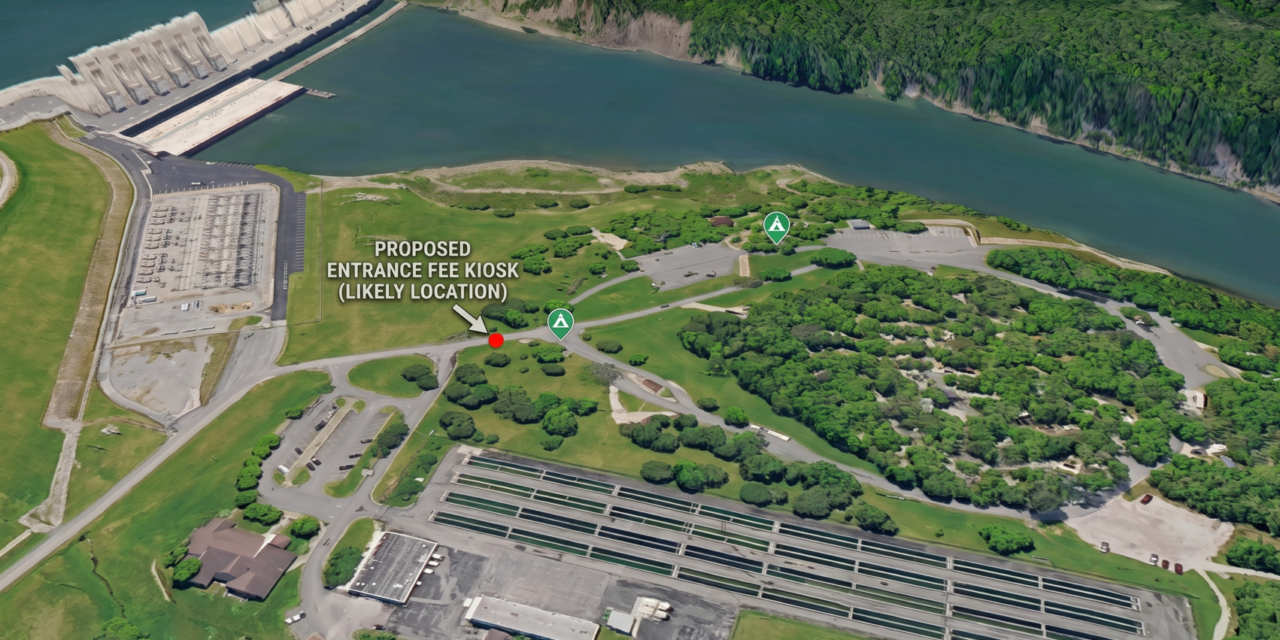
JAMESTOWN, KY — Following Russell County Online’s initial report breaking the news on the U.S. Army Corps of Engineers’ proposal to institute a $5 day-use vehicle fee at Kendall Recreation Area, community discussion and congressional opposition have focused heavily on public access.
Beyond access concerns, however, federal operational guidelines and visitor tracking data raise significant questions about the financial viability of the fee itself. An analysis of the numbers reveals that administrative overhead could consume the vast majority of the revenue generated.
1. The Real Day-Use Baseline
While broad regional tourism metrics record upwards of 150,000 annual visits to the basin immediately surrounding Wolf Creek Dam, the pool of visitors actually subject to a new vehicle day-use pass is far smaller:
- Excluded Traffic: Wolf Creek National Fish Hatchery visitors (managed separately by USFWS with free admission) and registered Kendall Campground users (whose camping permits automatically cover day-use access).
- Targeted Traffic: Casual bank anglers along the tailwaters, river kayakers, picnickers, and local sightseers—a group accounting for roughly 50,000 to 75,000 visits per year.
2. Federal Exemptions & Local Displacement
Under federal policy (16 U.S.C. § 460d-3), the Corps is required to grant 100% free day-use entry to holders of America the Beautiful Senior (62+) and Disability Access passes.
- High Senior Pass Usage: Given the high percentage of retired local bank fishermen using the tailwater, a substantial portion of daily vehicle traffic already holds qualifying federal passes.
- Price Elasticity: Recreation studies show an immediate 20% to 30% reduction in casual, short-duration local visits when a $5 fee is introduced, as users shift to non-fee access points along the river.
- Net Paid Volume: Accounting for exemptions, $40 annual passes, and local displacement, actual paid $5 transactions are realistically projected at 20,000 to 30,000 annually—yielding $100,000 to $150,000 in gross receipts.
3. Collection Overhead vs. Net Return
Generating that gross revenue requires physical or automated collection infrastructure:
- Operational Costs: Constructing an entrance station or deploying automated solar pay stations, paying Recreation.gov transaction cuts, software maintenance, and staffing a gatehouse during peak season (April–October) carries a standard annual operating cost of $50,000 to $80,000+.
- Diminishing Returns: Administrative overhead could swallow 50% to 80% of total gross receipts. If local avoidance is higher than expected, collection overhead threatens to consume virtually all revenue raised.
The Bottom Line
The data indicates that introducing a $5 entry fee at Kendall would create administrative friction and displace local residents while netting remarkably little usable revenue for park maintenance after collection costs are paid.
Russell County Online will continue to follow developments as public comment periods proceed.


